Thursday, December 17, 2015

When you drive a Tesla, just about everything else on road is a piece of crap


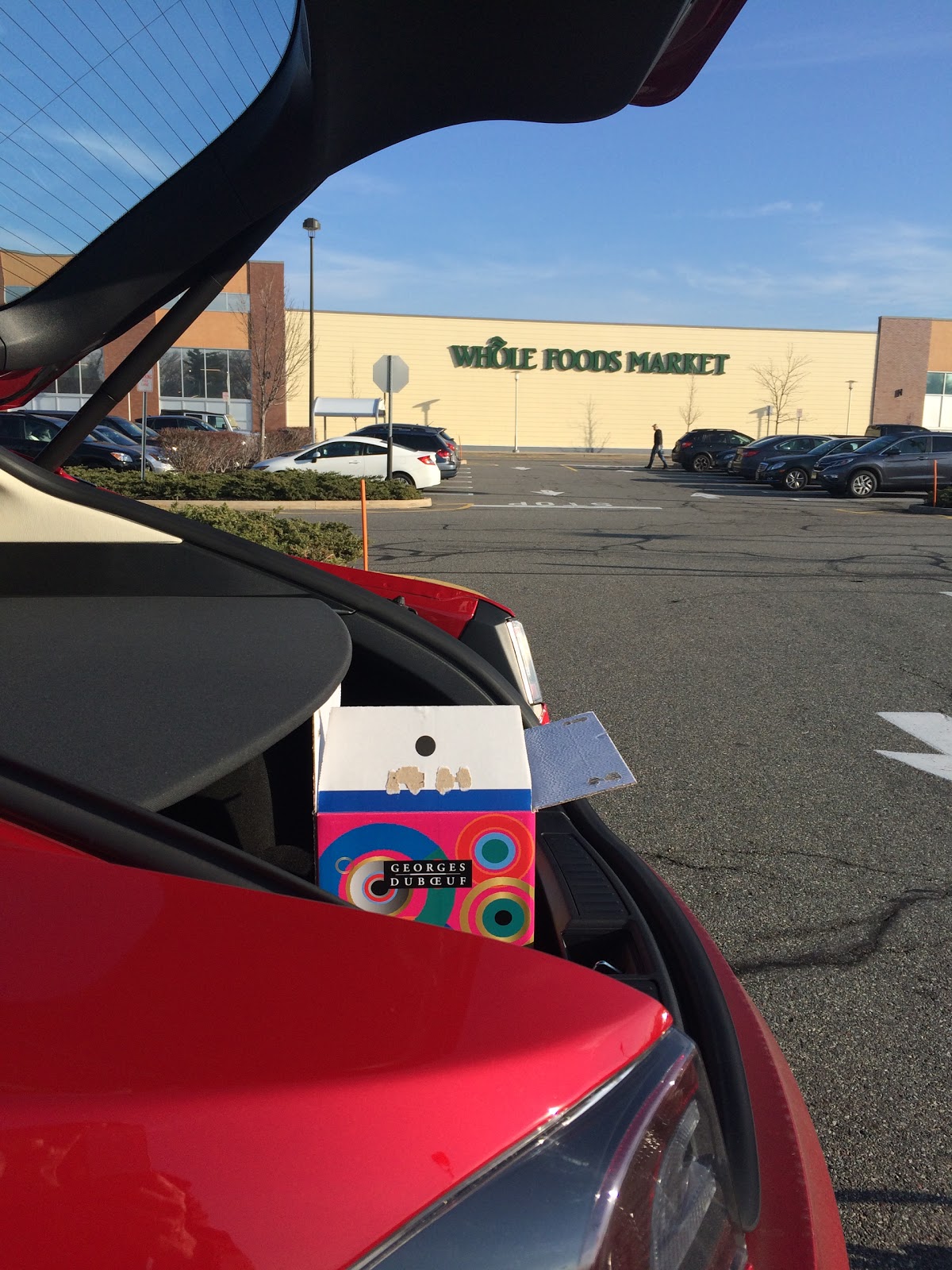
In trying to keep my 2015 Tesla Model S ding free, I usually park far away from the entrance of stores, as I did when I shopped a one-day sale on wine at Whole Foods Market in Paramus, N.J., above.


By VICTOR E. SASSON
EDITOR

On the way into Whole Foods Market the other day, I saw one of those enormous GMC Yukons that seemed to be wedged in between two other vehicles in the parking lot.

I wondered whether the overweight, middle-aged white guy behind the wheel of the gas guzzler could open the driver's door without dinging the far smaller vehicle next to him.

After I bought a zero-emissions Tesla Model S in April and started enjoying all of its great features -- including its exclusivity -- I started thinking of just about everything else on the road as so many pieces of crap.

What else can you say about gasoline- and diesel-powered cars that use antiquated technology to fill the air with fumes that are slowly killing people and noise that hounds them to their deaths?

I still have a lot of affection for the pioneering Toyota Prius, the gas-electric hybrid I drove from 2004-15 (I owned four, one of which we still have).

And I smile when I see a Nissan Leaf, BMW i3 or other all-electric vehicle. I've actually seen one Mercedes-Benz B Class with a Tesla drivetrain.

But I'm so disappointed the other German companies won't have any purely electric cars for another five years or more.

How arrogant.


Most of the controls and switches in the Tesla Model S are accessible on a large touch screen, which links the driver to the Internet.  And so is the owner's manual. Unlike a Mercedes-Benz I drove recently, you cannot turn off Tesla's back-up camera, but you can turn it on while driving, especially useful when you are changing lanes.


Too much noise

All of those shiny new Mercedes-Benzes, Audis, BMWs and Volkswagens, especially the performance models with loud mufflers, are so annoying.

And some of the biggest, priciest and most piggish Mercedes-Benzes earn poor marks from Consumer Reports when it comes to reliability.

Another thing that drives me crazy are all those TV commercials that show cars moving at insane speeds on race tracks or across desserts.

Did you see the Infiniti commercial showing a woman backing up the 400-horsepower, bus-like Q80 SUV over deep mountain snow?

Too bad it didn't go over the edge, and take the model behind the wheel with it.

I recently drove a Mercedes sedan, the $40,000 C300, and was shocked by the harsh ride and complexity of interior controls:

Levers, wheels, toggle switches and more, and a back-up camera that can be turned off! 

When I pulled the owner's manual out of the glove box, I learned that I would have to refer to a second manual to find out how to turn on the camera.


Near-silent running

You just can't beat a Tesla for its incredible speed from a standstill with no fuss, muss or noise. The Model S seems to just leap ahead.

Forget about the 0-60 mph time, which the automotive media obsess over.

In the suburban driving I do in northern New Jersey, 0-25 mph, 0-35 mph and 0-40 mph rule the road, and the Model S outperforms nearly everything else.

Is it my imagination that many other drivers want to race the Model S or just annoy me by tailgating?


I took advantage of a free-coffee promotion at a new Wawa in Hackensack, N.J.

Property taxes continue to climb for homeowners in Hackensack, where residents are saddled with three large tax-exempt entities, including Hackensack University Medical Center.


Boring Buick

On Tuesday, Tony DiSalle, U.S. vice president of Buick and GMC marketing, was scheduled to speak to members of the International Motor Press Association in midtown Manhattan.

I'm a member, but I skipped the program, which included free cocktails and a sumptuous buffet lunch, because what could DiSalle possibly say about the most boring car line in America?


Your father's Buick (a 1959 Electra 225 Riviera) was a knockout by the standards of the 1950s, but probably got 10 mpg and fell apart in a frontal crash, impaling the driver on the rigid steering column. 

'The charging regime'

I was struck by the accuracy of statements from Jeff Knight of the CAP Black Book in the United Kingdom on the lifestyle of a Tesla Model S owner.

As reported by EV Obsession and Gas2 blogs, Knight said:

"Many Tesla owners alter their lifestyle to fit the charging regime, because they are that passionate about the benefits of their vehicle.

"People clearly love this vehicle, which means it holds its value. 

"For anyone looking to buy an executive car with green credentials, but can handle the charging regime, a Tesla is one of the smartest investments in today's market."

Amen.

Monday, December 7, 2015

EVs and other green cars getting a smaller toll discount at Hudson River crossings

Drivers of gas-electric hybrid, plug-in and all-electric vehicles are getting less of a break after Sunday's hike in cash and EZ-Pass tolls at the Lincoln Tunnel, above, and all of the other crossings operated by the Port Authority of New York and New Jersey.


By VICTOR E. SASSON
EDITOR

Owners of more than 40 all-electric, plug-in and gas-electric hybrid models still can save $3.50 each time they use the George Washington Bridge and other Port Authority crossings.

On Sunday, the off-peak toll for cars with a "Green EZ-Pass" went up to $7 from $6.25 in 2014 and $5.50 in 2013.

The off-peak EZ-Pass toll for drivers of gasoline- and diesel-powered cars jumped to $10.50.

The hike is the last of five annual increases approved in 2011 by the Port Authority of New York and New Jersey.

Drivers of green cars pay $12.50, the same EZ-Pass toll as everyone else, during peak travel periods.

Off-peak travel

On Saturdays and Sundays, off-peak hours are before 11 a.m. and after 9 p.m.

On weekdays, off-peak hours are before 6 a.m., between 10:01 a.m. and 3:59 p.m., and after 9 p.m.

An even bigger discount goes to any driver with three or more people in the vehicle under the Port Authority's Carpool Plan.

The toll is only $6.50 at all times 7 days a week.

The Green and Carpool plans require pre-registration.

For eligible vehicles, see the following list:

Green EZ-Pass Vehicles

Wednesday, December 2, 2015

Cutting through the hype: Chevrolet Bolt EV price balloons to 'under$40,000'

This shot from a spy photographer is said to be a pre-production version of the Chevrolet Bolt EV that is scheduled to go on sale at the end of 2017 as a 2018 model.
The Chevrolet Bolt concept shown in January at the Detroit Auto Show.


By VICTOR E. SASSON
EDITOR

You can forget about an all-electric Chevrolet Bolt with a 200-mile range and a starting price of $30,000.

Now, according to the Gas2 blog, the 2018 Bolt will go on sale at the end of 2017 for "under $40,000."

That means the automotive media have a full two years to again change their reporting on the Bolt EV, which was first shown as a concept at the January 2015 Detroit Auto Show.

The latest spy photos show a four-door hatchback with a cab-forward design.

None of the production date and price information appearing on the Gas2 blog or in other media can be found on Chevrolet's official Bolt site.

And Chevrolet has said nothing about a network of fast chargers for the Bolt that would allow the EV to stretch its legs on long trips.

The success of Tesla Motors' Model S is attributed to a nationwide network of free Superchargers.


Tesla Superchargers at Hamilton Marketplace, a shopping center near Trenton, N.J. 


Although the automotive media have talked about a Bolt-Tesla battle, the Chevy doesn't look anything like media images of a smaller all-electric luxury car from Tesla Motors that will be unveiled in March, and go on sale in late 2017 for $35,000. 

Tesla CEO Elon Musk said in early September the Model 3 will start production in "about 2 years," as long as a battery factory under construction in Nevada is fully operational.

Friday, November 20, 2015

Consumer Reports calls Land Rover Discovery Sport one of year's worst

Consumer Reports names only four vehicles to its "Worst Cars of 2015" list, and the Land Rover Discovery Sport is one of them.


By VICTOR E. SASSON
EDITOR

How can you resist buying an SUV called the Disco?

That's how Consumer Reports magazine refers to the Land Rover Discovery Sport, which is on its short list of "Worst Cars of 2015."

Other "worst cars" are the Chrysler 200, Kia Sedona and Lexus NX 200t/300h.

"Its engine seems flat-footed and the transmission often feels in the wrong gear," the magazine's editors say of the Disco.

It gets worse: 

"Handling is lumbering, and the wheels ride as though made of concrete. The infotainment system seems dated."

The magazine's October 2015 issue notes, "Shoppers covet this eccentric English SUV brand for vanity reasons.... The Disco belongs to a family that includes the stately Range Rover."

The 2015 model started at $37,070.

Free lunch

Just a week ago, Jaguar Land Rover North America CEO Joe Eberhardt bought a big lunch for 60 members of the International Motor Press Association gathered in midtown Manhattan.

Eberhardt talked about new models and other measures the automaker hopes will boost anemic sales of its sports cars and SUVs in the United States.


Joe Eberhardt, CEO of Jaguar Land Rover North America, based in Mahwah, N.J.

Wednesday, November 18, 2015

A heavenly marriage: Solar shining on the roof, Tesla Model S charging in the garage

COMING UP FOR AIR: On Nov. 4, my all-electric Tesla Model S made its first visit to a gas station since I drove it home in mid-April to fill the Michelin tires with air -- 45 psi all around.

FREE ELECTRICITY: Charging my Model S at home costs me nothing, because I have more than 60 solar panels on the roof.


By VICTOR E. SASSON
EDITOR

My electric bill this month is exactly $2.43, a reduction from about $6 the month before.

With more than 60 solar panels on the roof of my home, charging my Tesla Model S costs me nothing.

In the past two months, the solar panels generated pretty much all of the electricity I needed to run appliances and lights, as well as charge the Model S crouching in the garage.

Unfortunately, I still have to choke on the fumes from huge SUVs and other vehicles that use fossil fuels, including those filthy, diesel-powered Volkswagens, Audis and Porsches.


OPEN WIDE: The hatchback in the Model S comes in handy at the hardware store or supermarket.

Friday, November 13, 2015

Jaguar Land Rover lays out big lunch, promises green cars in less than 5 years

Joe Eberhardt, right, president and CEO of Jaguar Land Rover North America, answering questions from Scotty Reiss, president of the International Motor Press Association, after a lunch in midtown Manhattan on Thursday.


By VICTOR E. SASSON
EDITOR

When I was a newspaper reporter covering auto importers based in northern New Jersey, Jaguar's luxury sedans and powerful sports cars were known as unreliable.

In fact, I recall writing a business story about Jaguar, based then in Leonia, identifying the car as the most accurate winter thermometer ever -- it would start at 33 degrees, but not below that temperature.

That was 30 years ago, but Jaguar Land Rover CEO Joe Eberhardt said on Wednesday the perception of unreliability still dogs the British marque.

That may be why Jaguar and Land Rover vehicles sell in such small numbers in the United States -- fewer than 68,000 units so far in 2015.

On Wednesday, Eberhardt bought a big lunch for 60 members of the International Motor Press Association, and announced new vehicles, lower MSRPs and other incentives to boost sales in the U.S.

And he said that to meet more stringent government gas-mileage standards on the horizon, the automaker plans to introduce such alternative power trains as hybrids, plug-in hybrids and fully electric vehicles within five years.

They couldn't come too soon given all of those enormous, gas-guzzling Range Rovers that are driven so aggressively in North Jersey's suburbs, most with a single occupant.

Eberhardt was asked to compare the company's previous owner, Ford Motor Co., to the current owner, Tata Motors of India, once a British colony.

He said Tata has provided the cash Jaguar Land Rover needs to develop new models and stay competitive.

ESI and the Teamsters

One of the tables on Thursday was occupied by managers of Event Solutions International, a fleet-management company.

ESI drivers deliver complimentary press vehicles from Jaguar, Land Rover and most other carmakers to auto writers in the Northeast.

ESI, now based in Somerset, N.J., has battled the Teamsters for about two years after the union organized drivers and promised them higher wages.

But some of the drivers, blaming the union for inaction, petitioned successfully for dissolution of the collective-bargaining agreement.

The average pay for drivers remains at about $12 an hour.


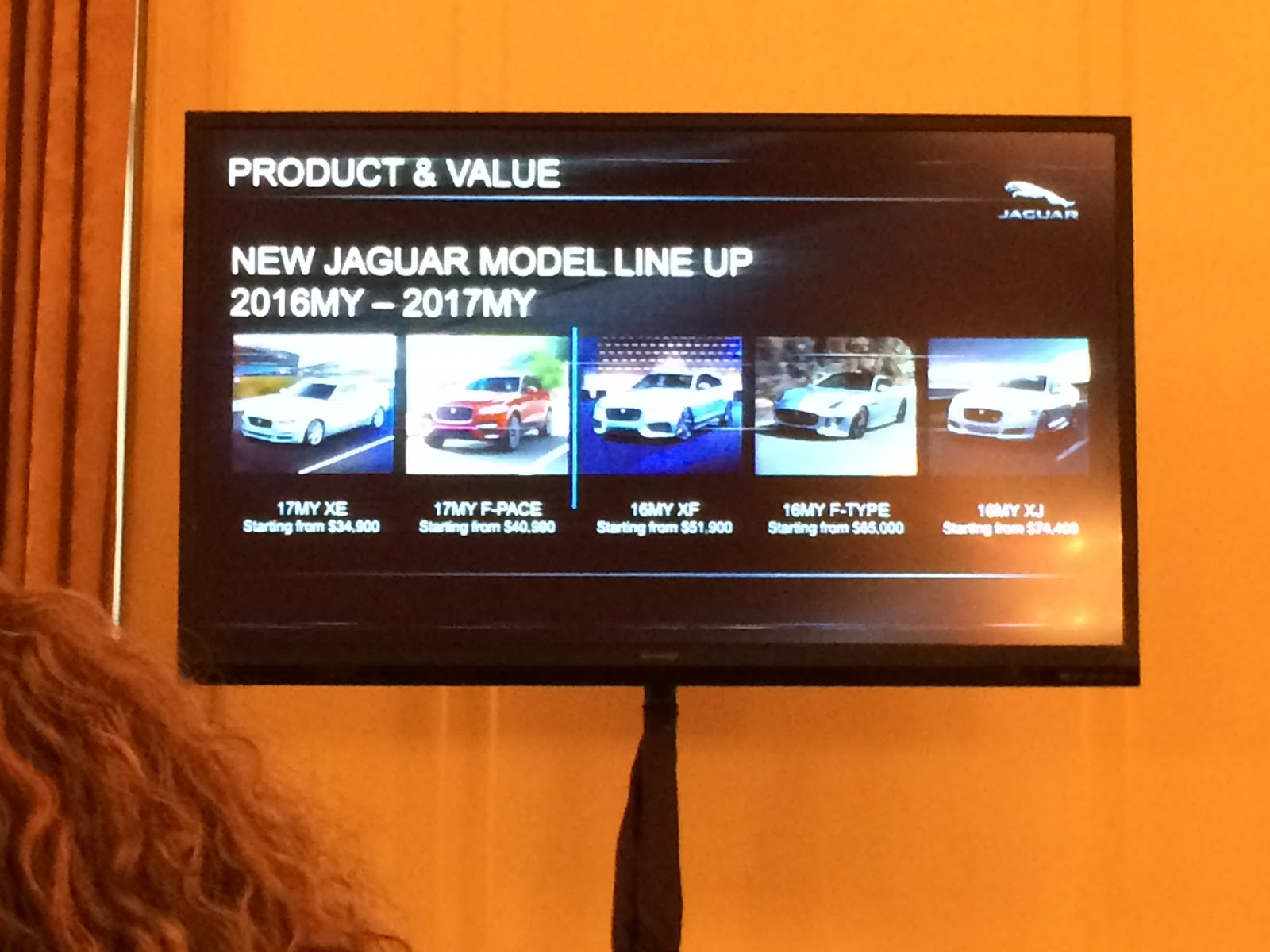
Among new models are the Jaguar XE compact luxury sedan and the F-Pace performance crossover, both in the 2017 model year.

Jaguar Land Rover, now based in Mahwah, N.J., is owned by Tata Motors, India's biggest automobile manufacturer, so look for snarling Jaguars in Bollywood movies.

Jaguar Land Rover treated members of the International Motor Press Association to an open bar and a delicious lunch, including falafel, mozzarella and tomatoes, shrimp ceviche, asparagus, guacamole, fresh fish, roasted chicken, fruit and an array of rich desserts.


Wednesday, November 11, 2015

Chevy Volt sales flop, VW diesel owners get crumbs, Mercedes controls from hell


A 2015 Chevrolet Volt, the plug-in gas-electric hybrid the news media insists on calling an electric car.


By VICTOR E. SASSON
EDITOR

What's all the shouting about?

Since 2011, Chevrolet has delivered about 85,000 Volt plug-in gas-electric hybrids in the United States and about 5,000 more in Canada.

That sounds like a sales flop to me, not a cause for celebration.

You'd have to add in sales in Europe and Australia through October to reach the 100,000-car milestone marked by the Gas2 blog and other media.

No one is saying how many hundreds of thousands of gallons of fossil fuel those cars burned or measuring how much pollution they poured into the atmosphere.

For a real success story, you have to look at Toyota, which sold more than 200,000 Prius gas-electric hybrids in each of the last three years.

From 2000 through December 2014, the Japanese automaker delivered nearly 1.5 million hybrids in the U.S. alone.

The Volt, including the redesigned 2016 model, represents the continuing failure of auto giant GM to answer Nissan and Tesla, leaders in all-electric cars.


A 2015 Volkswagen Beetle TDI powered by a turbodiesel, direct injection engine that is both peppy and far dirtier than the automaker acknowledged.


A real environmental disaster are the 11 million Volkswagen and Audi vehicles worldwide with the so-called clean-diesel engines that were rigged to cheat on government emissions test.

Now, Volkswagen of America is offering owners of 2009-15 vehicles in the U.S. two prepaid cards totaling $1,000.

That's just another way of saying, "Suckers."

Last week, the Environmental Protection Agency said some Audi, Porsche and VW models powered by a bigger V-6 diesel engine also contained the emissions cheating software.

Back-up camera puzzle

I drove a 2015 Mercedes-Benz C300 sedan on Tuesday, but was puzzled why no back-up camera went on when I put the transmission into reverse.

I fished out the owner's manual and found the page on turning on and turning off the camera, only to be referred to another manual I couldn't find.

Why in heavens would you want to turn off the camera?

I've driven Toyotas from 1986 through April of this year, when I took delivery of a Tesla Model S, and found the C300's interior controls a true nightmare when compared to those cars.

The Mercedes rode roughly over North Jersey's deteriorated streets, and all of the tossing motions made me more uncomfortable than I was in my 2010 Toyota Prius.

I feel sorry for the elderly woman who owns the car, because its advanced technology is almost totally inaccessible to her.

And to think the MSRP of this piece of crap is close to $40,000.